
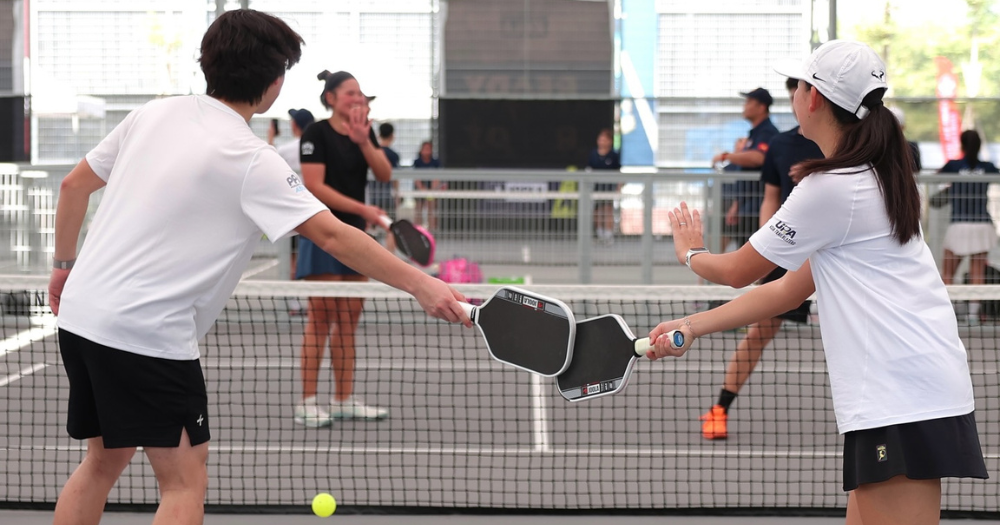
After spending 13 years in the table tennis industry, Kimberly Koh decided to take the lead as the managing director of the United Pickleball Association (UPA) Asia.
In 2024, Koh wanted to try something different and approach a different challenge.
That was when an acquaintance approached her and asked her to join the sport.
At the time, she did not know much about pickleball, but what intrigued her was how people who were not into sports found a gateway sport for them to play.
For the next year and a half, Koh watched as courts sprang up around the region, and she travelled around Asia, talking to players and spectators, where the passion rubbed off on her.
Now, Singapore will be one of the stops for one of the largest pickleball competitions in the region.
A clean slate
Speaking to Mothership, Koh shared that UPA Asia started from a clean slate, and she had to figure out how to introduce pickleball to the market.
Despite pickleball being in Singapore for over 50 years, the sport often appeals to older generations.
However, the mentality began to change as the sport became “trendier”, and soon other regions were playing it as well.
UPA Asia first introduced its trailblazer programme to scout for talent in Southeast Asia before launching the first Professional Pickleball Association (PPA) Asia tour in 2025.
For its 2026 calendar, PPA Asia added Singapore as one of its tour stops, something that was not easily achieved in Singapore.
Koh shared that the challenge for Singapore was to change the perception that this sport is not just for older folks, but that the youth could enjoy it as well.
As for the noise complaints surrounding the sport, she views them as a good thing, as they show strong demand for the sport and for players using unused facilities.
She said: “It’s a good thing, because it shows that there’s a lot of demand for the sport and people are just trying to make use of unused facilities. The facilities do happen to be around housing areas, and so they do tend to cause a lot more noise. But because people know that there is this demand, we do believe that sooner rather than later, there’s going to be a lot more supply of proper courts for pickleball coming up.”
And Koh is right — during a recent parliamentary debate, Acting Minister for Culture, Community and Youth (MCCY) David Neo announced that the government will be building 50 multi-purpose courts islandwide, over the next five years.
On whether pickleball will be a fad that eventually dies out, Koh cited the sport’s growth in the U.S as an example of the sport’s potential.
“The growth of the sport has just been incredible the last few years. But also, businesses and communities, for example, come together to show that there is truly a long-term interest in the sport itself,” said Koh.
She notes that having more facilities would help to contribute to the sport, giving it fixed homes.
“We want to be able to bring more PPA tournaments to Asia as well. One of the challenges that we definitely do face is always facility,” she added.
She shared that having dedicated facilities for players and spectators would help in the long run.
“Ultimately, pickleball is something that makes people move about, it uses your brain. The sport is not just about smacking stuff. It is also about the strategy, teamwork and just fun.”